
Potomac Environmental Research and Education Center

Ecotoxicology of microplastics in the Potomac River watershed: Effects on Aquatic Organisms, Mechanisms of Fragmentation, and Vectors of Micropollutants and Microbial pathogens

Written by Maria Rumyantseva

There have been numerous discussions on the issue of water contamination, and one might ask what novelty could this project possibly bring about? Well, the pandemic summer of 2020 dictated a new twist as the faculty members as well as students must have adjusted and adapted to a new condition with resilience, enthusiasm, creativity, and flexibility. In this blog I will share my personal experience participating in the project, I will describe the research process for a meta-analysis and how we decided to attain that virtually.
Hunting Creek Research

Alexandria Renew Enterprises featured our Hunting Creek research in a recent video.


RiverRenew on Vimeo.

35-Year Study of Gunston Cove Published

For 35 years, Dr. Chris Jones has sampled Gunston Cove, a tributary to the Potomac. He has recently published a long-term study, tracking the ecosystem’s recovery. The results of his research indicate that submerged aquatic vegetation (SAV) have returned (previously, there was none) as a result of increased water clarity. SAV provide important habitats for fish and invertebrates in the Potomac River. While there is still a long-way to go, this study demonstrates that it is possible to recover ecosystems that have been damaged by pollution. You can read Recovery of a Tidal Freshwater Embayment from Eutrophication: a Multidecadal Study here.

Abstract: 

Effective management of eutrophication in tidal ecosystems requires a thorough understanding of the dynamics of their responses to decreases in nutrient loading. We analyze a 34-year dataset on a shallow embayment of the tidal freshwater Potomac River, Gunston Cove, for long-term responses of ambient nutrient levels, light transparency measures, phytoplankton biomass, and coverage of submersed aquatic vegetation (SAV) to decreased nutrient loading. Point source loading of phosphorus, the nutrient most limiting primary production in this system, was greatly curtailed coincident with the study onset (1983/84) exhibiting a sharp decrease of 95% from peak loading levels. However, water column total phosphorus decreased much more slowly and gradually. Phytoplankton chlorophyll a did not show a distinctive decrease until 2000 and SAV responded strongly beginning in 2004. The habitat suitability model for SAV developed by Chesapeake Bay researchers was able to explain the recovery of SAV coverage based on data on light transparency and basin morphometry collected in this study. The study results were consistent with the alternative stable state theory with a sharp transition from a phytoplankton-dominated “turbid water” state to an SAV-dominated “clear water” state in a 2-year period from 2003 to 2005. The system eventually responded to nutrient load reductions, but the nonlinear and incomplete nature of this recovery and the two-decade delay illustrate the complexities of managing these systems.

Student Accomplishments

Congratulations to the students of Dr. Kim De Mutsert on the following accolades:

Students and Dr. De Mutsert at the ecopath conference
L-R: Casey Pehrson, Dr. Kristy Lewis (University of Central Florida), Dr. Kim de Mutsert, Sara Marriott, and Sammie Alexander.

Sara Marriott was awarded a prestigious SESYNC Graduate Pursuit Fellowship, which is an an 18-month fellowship in which she is part of an interdisciplinary team that will be researching “A socio-environmental approach to improve offshore aquaculture and policy: Gulf of Mexico case study.” It supports travel and meetings to conduct research, provides access to SESYNC workshops and resources, as well as a stipend/honorarium of $2,000.

Sammie Alexander received a $5,000 program development award from Virginia Sea Grant for her project: “Assessment of fish passage use and success in facilitating movement of regionally vulnerable and invasive fish species in northern Virginia portion of the Potomac River.” This is the second award she has received from VA Sea Grant.

Kate Russel with her winning poster

Casey Pehrson was awarded the Robert D. Ross Graduate Scholarship in fisheries and related aquatic sciences from the Virginia Chapter of the American Fisheries Society. She received the second place award, which comes with a $250 check.

Katie Russell won the best undergraduate poster award at the Virginia Chapter of the Wildlife Society Conference that was held this week.

R. Chris Jones Wins Jack Wood Legacy Award

Board of Visitors Meeting. photo by Evan Cantwell/Creative Services

Chris Jones wins 2019 Jack Wood Legacy Award!

Dr. R. Christian Jones, Director, Potomac Environmental Research and Education Center, Environmental Science and Policy, began a long-term “green to clean” partnership in 1984 by collaboratively developing a monitoring plan designed to document algae counts, monitor water quality, fish, invertebrates and aquatic plants in Gunston Cove, downstream from the Noman Cole wastewater treatment plant, which at that time had just implemented a new protocol that removed phosphorus, an essential nutrient for algae growth, from the purified water they returned to the river. This partnership has helped train and launch careers of dozens of students, and paved the way for additional community collaborations, culminating in the creation of the Potomac Environmental Research and Education Center (PEREC), and the building of its home, Mason’s Potomac Science Center. For the past seven years, in partnership with Alexandria Renew Enterprises, Dr. Jones’ PEREC team has initiated a more multifaceted study to document water quality and aquatic ecosystem trends in Hunting Creek, downstream of the AlexRenew wastewater treatment plant. Long-term partnerships such as these, and others with Fairfax and Prince William Counties, has fostered mutually beneficial relationships with a multitude of local, state, and national agencies and organizations, while bettering the quality of life for the community.

Potomac Science Center Dedication

This week, the public were welcomed to the Potomac Science in Belmont Bay, for the Potomac Science Center Dedication Ceremony!

The event was highlighted by several publications:

Fairfax County EQAC Environmental Excellence Award, 2014

PEREC has been recognized by the Environmental Quality Advisory Council with the organizational award for the dedication of “time and energy to benefit the environment and support county environmental goals and initiatives.”

View all of the award winners on the Fairfax County website.

George Mason Program Minimizes Pollution in Potomac and Chesapeake, and Educates Kids

Originally published in the Washington Post Blogs, June 12, 2012

Flushing: We all do it, mostly without any thought beyond the pipe leading away from our home. But if you follow what spirals out of sight down a toilet or household drain, the end of the line for that human wastewater is the Potomac River and the Chesapeake Bay for a large portion of Fairfax County residents. In the 1960s, the Potomac was green from the algae and bacteria of human sewage and storm runoff.

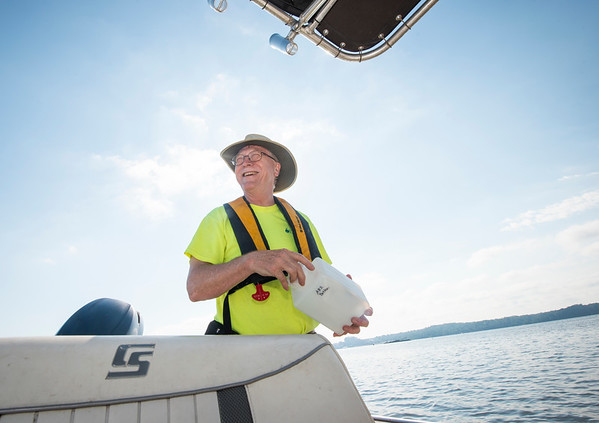
Piloting an open-top fishing boat out to designated monitoring locations, Chris Jones, the director of George Mason University’s Potomac Environmental Research and Education Center (PEREC), monitors today’s wastewater as it re-emerges from pipes and rejoins natural space in Gunston Cove. The center has been working to clean up the Potomac and Chesapeake Bay since 1980. [end of excerpt]

Read the full article on the Washington Post website.

Virginia Mathematics & Science Coalition 2012 “Programs that Work” Award Winner

Virginia Mathematics & Science Coalition 2012 “Programs that Work” Award Winner with Prince William County Schools. VMSC recognizes exemplary mathematics, science, and integrated science, technology, engineering, and mathematics (STEM) programs for which there is evidence of a positive impact on student or teacher learning.

PEREC Cited as Business Partner of the Year for Prince William County Public Schools

Originally published on the Prince William County Public Schools website, May 19, 2011

Chesapeake Bay Education Partners and the Prince William County Public Schools (PWCS) Office of Science and Family Life EducationChesapeake Bay Education Partners with School Board members: Superintendent Walts, representatives of Alice Ferguson Foundation, George Mason University, E.A.G.L.E. project, Forest Service, and Sharon Henry

The Chesapeake Bay Education Partners (which includes the Alice Ferguson Foundation, the George Mason University Potomac Environmental Research and Education Center, Manassas National Battlefield, Occoquan Bay U.S. Fish and Wildlife Refuge, and Prince William Forest National Park) work together to support Prince William County’s environmental education program, “From the Mountains to the Estuary: From the Schoolyard to the Bay.” The partnership provides meaningful watershed experiences for thousands of students, aligned with existing curriculum objectives already taught in the classroom. (The partnership was nominated by Joy Greene, E.A.G.L.E. project coordinator.)