After nearly 20 years of planning and work at multiple levels of government, Prince William is now home to the newest segment of the historic Potomac Heritage National Scenic Trail — an 800-mile network of locally managed trails along the Potomac River.
The new segment, while only 1 mile long, is a key part of the trail because it finally connects the eastern Woodbridge community of Belmont Bay to Veterans Memorial Park via the Occoquan Bay National Wildlife Refuge. The addition is part of a trail segment that will eventually connect Mount Vernon with Quantico. Read more.
Category: Blog

There is a brand new mural at Potomac Science Center! The mural was painted by TakerOne, an artist who hails from Hungary.
New mural at Mason’s Potomac Science Center highlights native species
There’s a guy spray-painting a wall in the Belmont Bay area of Woodbridge, Virginia, and the community members couldn’t be happier.
The guy is international graffiti artist TakerOne, and the wall he is working on belongs to George Mason University’s Potomac Science Center. His mural, “Fauna of Belmont Bay,” is part of the Murals at Mason’s larger eco-consciousness mural series titled Elements, and the result of a university-community partnership.
In the “Fauna of Belmont Bay,” the muralist and street artist from Budapest, Hungary, highlights four species that inhabit Belmont Bay: the yellow swallowtail butterfly (Papilio glaucus), the tree frog (Hyla cinerea), the wood duck (Aix sponsa), and the North American river otter (Lontra canadensis). Read more.
New Belmont Bay mural showcases wildlife native to the Potomac
On his website, TakerOne says he wants people to stop and say “wow” when they see his work. His goal is to add color to gray cities and to “beautify our built environment” on a grand scale. Last week, TakerOne began creating a mural on the science center’s parking garage that highlights the biodiversity of the Potomac River one spray can at a time. Read more.
- *The programs and services offered by George Mason University are open to all who seek them. George Mason does not discriminate on the basis of race, color, religion, ethnic national origin (including shared ancestry and/or ethnic characteristics), sex, disability, military status (including veteran status), sexual orientation, gender identity, gender expression, age, marital status, pregnancy status, genetic information, or any other characteristic protected by law. After an initial review of its policies and practices, the university affirms its commitment to meet all federal mandates as articulated in federal law, as well as recent executive orders and federal agency directives.
When Dr. Don Kelso joined the Mason faculty in 1970, both the university, and the field of environmental science, were just getting started. A pioneering aquatic ecologist, Kelso remained a fixture within the Department of Biology, and Mason, for the next 35 years until retiring in 2006.
A mentor and friend to hundreds of students, he was a key figure in establishing the PhD program in Environmental Science and Public Policy in 2000, the first PhD program in the sciences at Mason and the first doctoral program of its kind in the country.
Now a group of Kelso’s former students have united to honor his legacy at the Potomac Science Center, the waterfront environmental research center that Kelso played a central role in establishing.
On May 22, a group of over 30 former students, colleagues, and family gathered with Kelso at the Potomac Science Center to celebrate and thank him for his positive influence on their lives. They also kicked off a campaign to fund and build the Don Kelso Learning Pier.
- *The programs and services offered by George Mason University are open to all who seek them. George Mason does not discriminate on the basis of race, color, religion, ethnic national origin (including shared ancestry and/or ethnic characteristics), sex, disability, military status (including veteran status), sexual orientation, gender identity, gender expression, age, marital status, pregnancy status, genetic information, or any other characteristic protected by law. After an initial review of its policies and practices, the university affirms its commitment to meet all federal mandates as articulated in federal law, as well as recent executive orders and federal agency directives.
Here at Mason, COVID-19 cases can be caught early, because researchers at Potomac Science Center are testing sewage for COVID-19 RNA.
- *The programs and services offered by George Mason University are open to all who seek them. George Mason does not discriminate on the basis of race, color, religion, ethnic national origin (including shared ancestry and/or ethnic characteristics), sex, disability, military status (including veteran status), sexual orientation, gender identity, gender expression, age, marital status, pregnancy status, genetic information, or any other characteristic protected by law. After an initial review of its policies and practices, the university affirms its commitment to meet all federal mandates as articulated in federal law, as well as recent executive orders and federal agency directives.
A student from Dr. Cindy Smith‘s undergraduate environmental science course was recently interviewed for GMU’s news. Distance learning has been a challenging for the whole university, but PEREC faculty and students have gone out of their way to find new and unique learning opportunities.
Smith said she had several students who expanded the original assignment. She attributes that to the remote learning forced by the pandemic.
“They have to locate their own study sites,” Smith said, “and because they set up their own, they have to think more critically about how they collect their data and what their results might mean for human and environmental health.”
“Dr. Smith and [teaching assistant and Mason PhD student] Chelsea Gray have been incredible throughout this whole thing,” O’Keefe said. “They’re involved, supportive and proactive, and they connect to their class.”
Read the rest here: https://www2.gmu.edu/news/592441?fbclid=IwAR2KvQijPzAJs-d8uVnLCkqOzPx5rxQjeVebYfyzhB5SD2zOI_LQlHnNkUU
- *The programs and services offered by George Mason University are open to all who seek them. George Mason does not discriminate on the basis of race, color, religion, ethnic national origin (including shared ancestry and/or ethnic characteristics), sex, disability, military status (including veteran status), sexual orientation, gender identity, gender expression, age, marital status, pregnancy status, genetic information, or any other characteristic protected by law. After an initial review of its policies and practices, the university affirms its commitment to meet all federal mandates as articulated in federal law, as well as recent executive orders and federal agency directives.
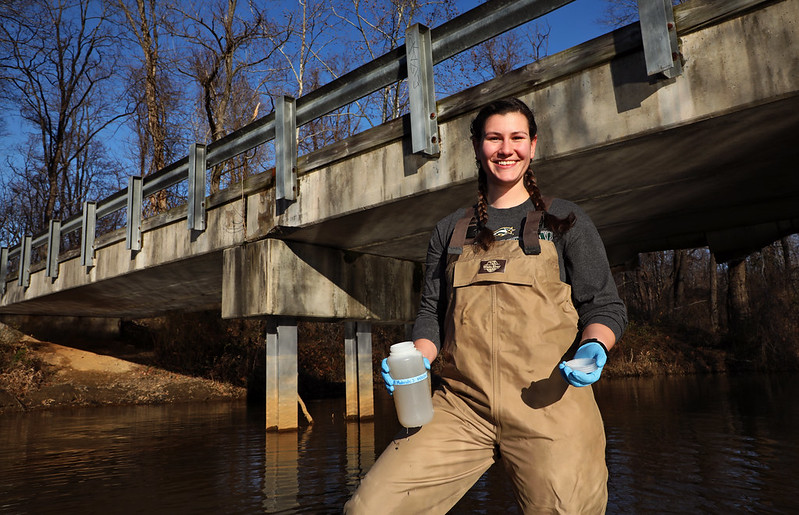
Cover photo: Sammie collecting samples, photo by Aileen Devlin, Virginia Sea Grant
Sammie Alexander, a Master’s student of Environmental Science and Policy, is a lead author on her first study, published with Dr. CJ Schlick and Dr. Kim de Mutsert (Read it here). Learn about her journey as a young scientist and researcher and the surprising ways scientific questions can arise.
- *The programs and services offered by George Mason University are open to all who seek them. George Mason does not discriminate on the basis of race, color, religion, ethnic national origin (including shared ancestry and/or ethnic characteristics), sex, disability, military status (including veteran status), sexual orientation, gender identity, gender expression, age, marital status, pregnancy status, genetic information, or any other characteristic protected by law. After an initial review of its policies and practices, the university affirms its commitment to meet all federal mandates as articulated in federal law, as well as recent executive orders and federal agency directives.
Written by Monica Zaky

What if I told you that your facial scrub may be adding to the abundance of plastics in our rivers, lakes, and oceans? Those microbeads that exfoliate your face are often made of plastic. Plastics are everywhere. They are used for packaging, beauty supplies, agriculture, furniture, and even our cars. Sadly, a lot of plastics end up in water of some sorts; in creeks, streams, rivers, lakes, and oceans, plastics are there, and they are becoming unavoidable. Large plastics break down into tiny pieces called microplastics, or plastics that are less than 5mm in length. Microplastics may come from anything such as clothing to beauty products such as a facial scrub. How many of these plastics are in our water systems, and how might they be interacting with other pollutants in the water?
- *The programs and services offered by George Mason University are open to all who seek them. George Mason does not discriminate on the basis of race, color, religion, ethnic national origin (including shared ancestry and/or ethnic characteristics), sex, disability, military status (including veteran status), sexual orientation, gender identity, gender expression, age, marital status, pregnancy status, genetic information, or any other characteristic protected by law. After an initial review of its policies and practices, the university affirms its commitment to meet all federal mandates as articulated in federal law, as well as recent executive orders and federal agency directives.
Written by: Mark Derco
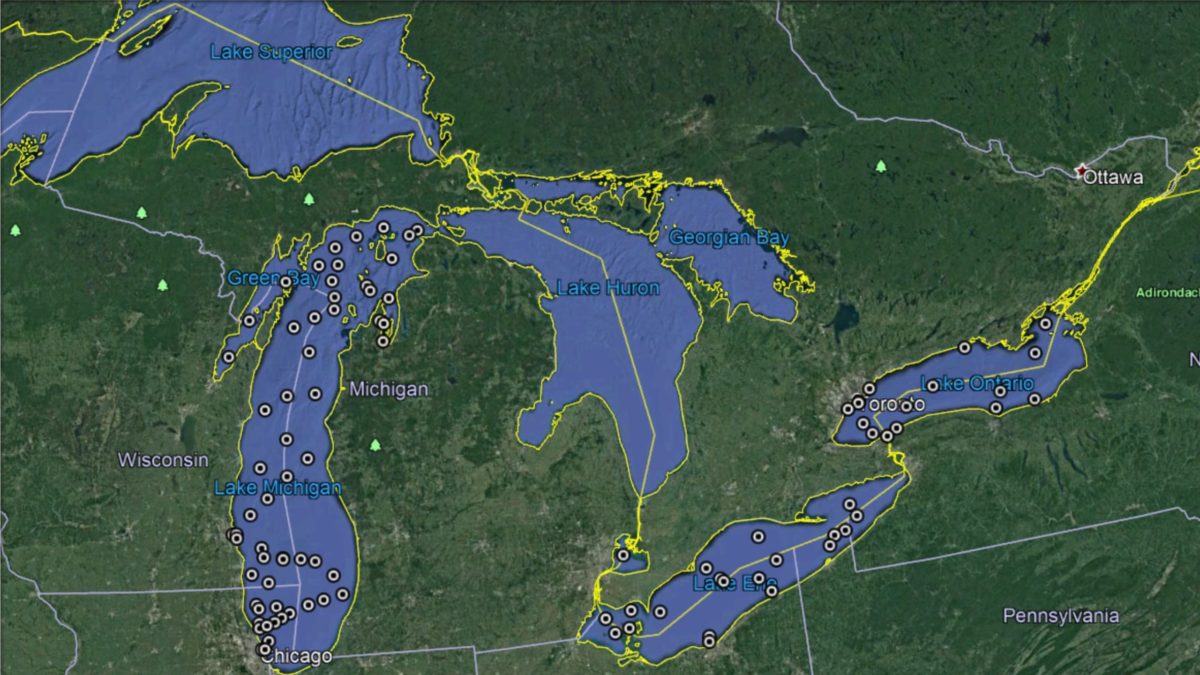
The great lakes are the largest coalition of freshwater lakes in the world and paramount to the success of the cities that border the lakes. However, the success of the lakes depends on the cities around them. For years industry has been contributing to the pollution of the great lakes and with this research we are looking to fill a gap in knowledge that will help us track the movement of these pollutants throughout the great lakes and in other regions of the United States.
- *The programs and services offered by George Mason University are open to all who seek them. George Mason does not discriminate on the basis of race, color, religion, ethnic national origin (including shared ancestry and/or ethnic characteristics), sex, disability, military status (including veteran status), sexual orientation, gender identity, gender expression, age, marital status, pregnancy status, genetic information, or any other characteristic protected by law. After an initial review of its policies and practices, the university affirms its commitment to meet all federal mandates as articulated in federal law, as well as recent executive orders and federal agency directives.
Written by Maria Rumyantseva
There have been numerous discussions on the issue of water contamination, and one might ask what novelty could this project possibly bring about? Well, the pandemic summer of 2020 dictated a new twist as the faculty members as well as students must have adjusted and adapted to a new condition with resilience, enthusiasm, creativity, and flexibility. In this blog I will share my personal experience participating in the project, I will describe the research process for a meta-analysis and how we decided to attain that virtually.
- *The programs and services offered by George Mason University are open to all who seek them. George Mason does not discriminate on the basis of race, color, religion, ethnic national origin (including shared ancestry and/or ethnic characteristics), sex, disability, military status (including veteran status), sexual orientation, gender identity, gender expression, age, marital status, pregnancy status, genetic information, or any other characteristic protected by law. After an initial review of its policies and practices, the university affirms its commitment to meet all federal mandates as articulated in federal law, as well as recent executive orders and federal agency directives.
Written by Grace Loonam

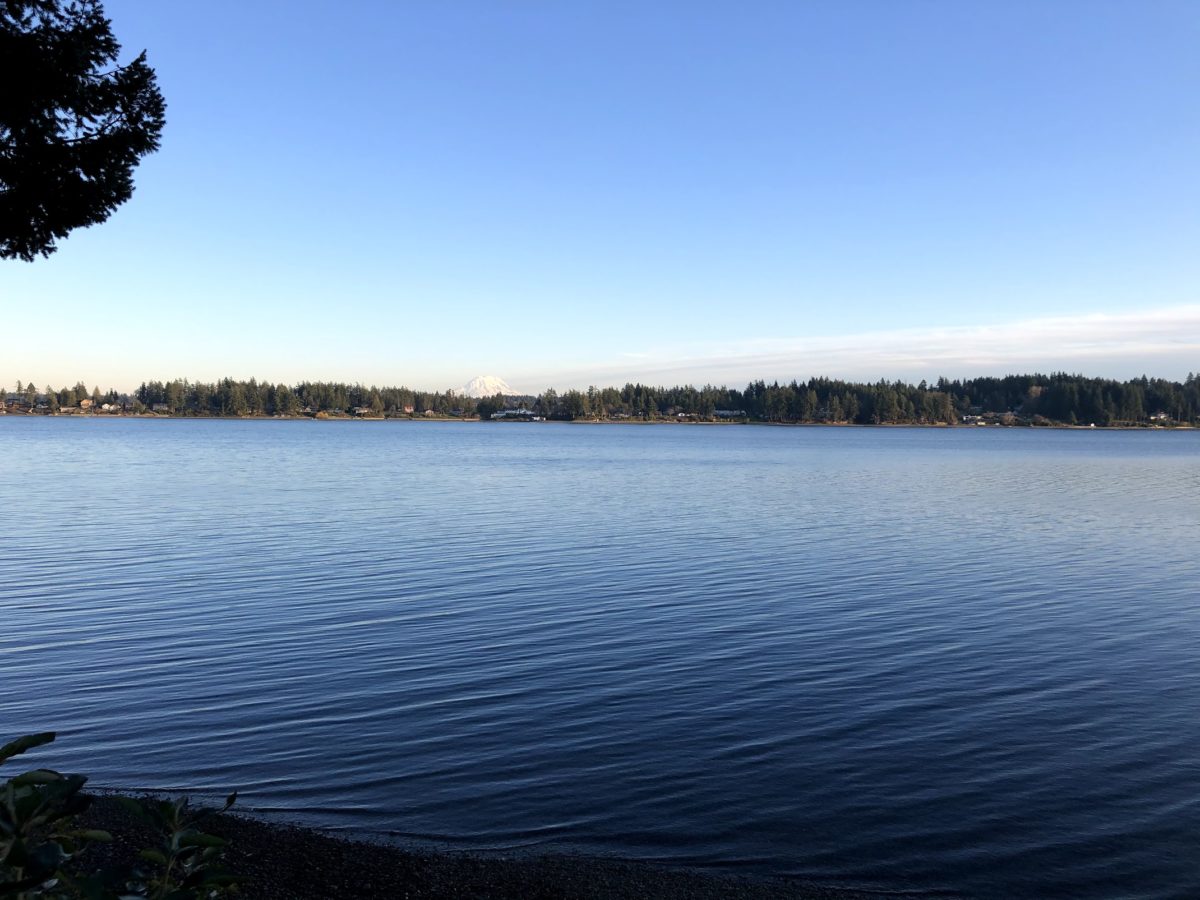
Initially, when considering the possibility of toxic plastic pollution, images of ominous floating garbage patches in the ocean may come to mind, as it is easy to picture how this waste could disrupt and harm aquatic life. This summer, I am working on a remote group project concerning the ecotoxicology of a less visible, but no less significant threat: microplastics. Microplastics, defined as pieces of plastic less than five millimeters in length, have become a subject of increasing interest and study, and numerous investigations targeted towards mapping their concentration and distribution in the aquatic environment have been conducted. Although my fellow researchers and I were initially planning on characterizing this issue in the Potomac River ecosystem, the need to work remotely has led us to instead analyze previous research that contains microplastic concentration data of distinct regions around the United States. We also collected pollutant data in the same regions, and I specifically looked in San Francisco Bay, Puget Sound, and the Mohawk River for this information.
- *The programs and services offered by George Mason University are open to all who seek them. George Mason does not discriminate on the basis of race, color, religion, ethnic national origin (including shared ancestry and/or ethnic characteristics), sex, disability, military status (including veteran status), sexual orientation, gender identity, gender expression, age, marital status, pregnancy status, genetic information, or any other characteristic protected by law. After an initial review of its policies and practices, the university affirms its commitment to meet all federal mandates as articulated in federal law, as well as recent executive orders and federal agency directives.